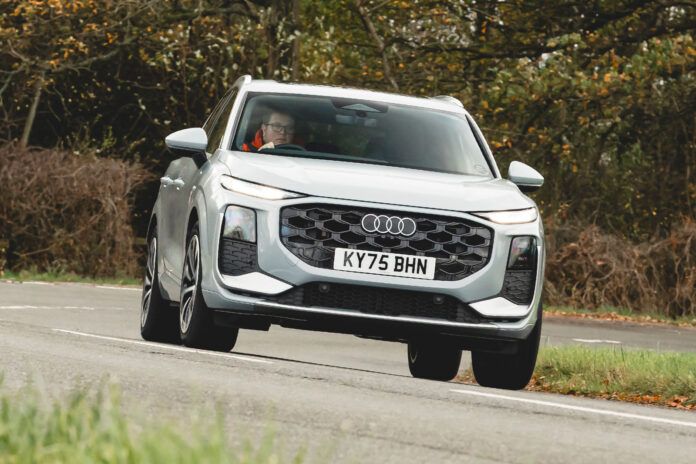
It may be defined as a compact SUV – and the lightest-available version, at that – but our 1.5-litre TFSI Q3 still weighed just over 1.6 tonnes on the proving ground scales. Is 148bhp and 184lb ft enough to move that mass in a suitably premium-feeling way? The answer isn’t clear-cut – and may say as much about your expectations as it does this car – but is worth exploring anyway.
The four-cylinder turbocharged petrol sets about its task well enough. Torquey from low revs, it gets the car moving and up to urban speeds without needing big dabs of power, working in tandem with a smooth-shifting dual-clutch automatic gearbox that times its actions fairly well. At low and medium revs it remains quite hushed and well mannered.
But out of town – and when you have more demands to make of it, bigger speeds to reach and gaps in traffic to squeeze into – you find the limits of the engine’s potency fairly regularly. The engine doesn’t rev very willingly beyond 4000rpm, and begins to feel a little gutless when you need assertive roll-on acceleration beyond 50mph. Here the gearbox seems slightly slow and hesitant when kicking down, and acceleration begins to feel quite noisy and laboured.
That subjective sense was made manifest in an undistinguished 0-60mph of 9.4sec, and 30-70mph in 8.9sec. The latter makes the Q3 slightly quicker than the identically engined Volkswagen Tiguan we tested in 2024 (whose laboured performance we also criticised). But the 138bhp Mazda CX-30 e-SkyActiv G mild hybrid – a compact SUV about 75% of the Audi’s price that we tested last year – was 1.3sec quicker from 30-70mph and 1.4sec quicker from 50-80mph.
We also noted, when attempting to record in-gear acceleration benchmarks, a slightly wilful streak about the car’s automatic transmission that refuses to hold a selected ratio under full power when you have selected a gear using the paddle shifters but rather kicks down autonomously – even when you’re careful not to push past the pedal’s kickdown detent. This ultimately seems like an attempt to cover for a powertrain that feels a little bit unworthy – and prevents the interested driver from exercising the full control he or she might prefer.
Elsewhere in the range, the 2.0-litre ‘EA888’ engine (as made famous by the Volkswagen Golf GTI) comes in two states of tune here: 201bhp and 261bhp. Both come with a Quattro clutch-based all-wheel drive system.
Both feel quick; the latter the more urgent, as you would expect. Audi’s twin-clutch gearbox is quick- and smooth-acting when left in ‘D’; but, because it’s only got ‘micro hybrid’ stop-start, there are moments when the engine feels slow to rouse itself in traffic and at junctions, making it feel just a little bit antiquated. The 2.0-litre TFSI pulls strongly both through the mid range, and keeps revving well; but it isn’t the most hushed unit of its kind, and doesn’t lend the Q3 a great deal of refinement or richness. Flexibility is a better advert for it than outright cruising quietness; so we’d say, if you want the best-mannered Q3 in the set, consider the eHybrid.
There’s also a front-driven 2.0-litre diesel. This same TDI unit is used in a load of Volkswagen Group cars, from the Skoda Octavia to the Audi A3. It’s expected to take less than 10% of Q3 sales, which is a shame. It’s a bit chattery on start-up, but It’s quiet enough on the move and can completely be left to its own devices with the gearbox. There’s even enough power for you to tease out a bit of torque steer.
The PHEV comprises a 1.5-litre turbo petrol engine, a 19.7kWh (usable) battery and an electric motor, making 269bhp in total. It’s quick, although acceleration is quicker and more succinct in gear than off the line. The transition from electric to petrol power is smooth. Even when there’s no charge in the battery it’s an effortless thing to use, and you don’t feel hugely short-changed by the drop in performance. The all-important electric-only range has been increased from the previous generation’s 30-ish miles to 70-ish miles, which effectively changes the remit of its EV driving capacity from handy for some to useful for many.
There are a few quirks with the PHEV, mind you. You have to push past a proper ‘golf ball’ in the accelerator travel in order to unlock all of its potential on the throttle, and the brakes are spongy. I found that I needed to push a lot harder on the pedal compared with the ICE cars. And as with all PHEVs, you will pull away from a roundabout at some stage, foot hard to the floor, not quite entering the flow as fast as you would have liked, because you’re waiting for the engine to kick in. Other than that, it’s pretty smooth sailing.

