When Miguel Galluzzi stripped a Ducati 888 of its fairings and sketched a fuel tank that looked like a muscular hunchback, he wasn’t just designing a bike—he was inventing a category. Launched in 1993, the Ducati Monster (or Il Mostro) adhered to a simple, yet brutal philosophy: “All you need is a saddle, tank, engine, two wheels, and handlebars.” It was the original factory streetfighter, a trellis-framed hooligan that accounted for nearly half of Ducati’s worldwide sales for decades.
Over the years, the Monster has evolved from the air-cooled M900 to the liquid-cooled, 140-hp superbikes-in-disguise, such as the S4RS. While the newest generation has ditched the trellis frame for a front-frame design—a move that still causes heated debates in Italian espresso bars—the spirit of the Monster remains unchanged. It is a bike designed to be seen, heard, and modified.
We have witnessed the Monster transformed into everything from futuristic café racers to dirt-track sliders. Here are six of our favorite iterations of the beast.
Rough Crafts ‘Savage’ New-Gen Monster
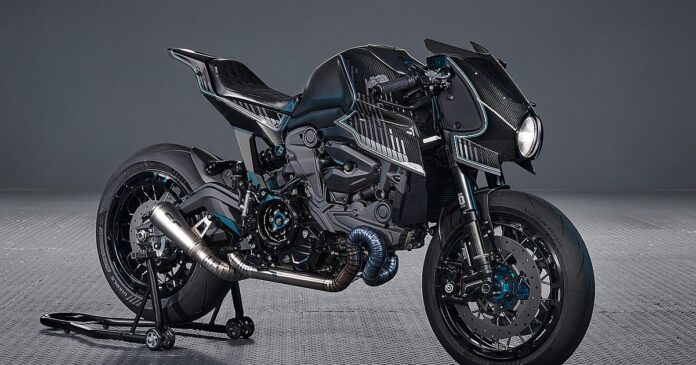
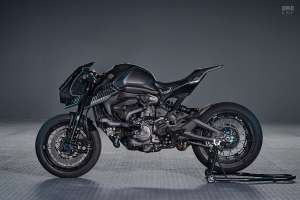
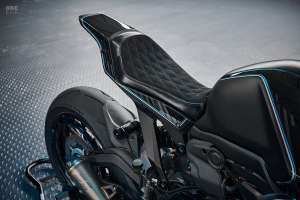
While purists mourned the loss of the trellis frame on the 937cc Monster, Winston Yeh of Rough Crafts saw an opportunity. For a client wanting high-tech race elements blended with retro styling, Winston stripped the tightly packed modern machine and started from scratch. He replaced the molded plastic tail with a stunning CNC-machined aluminum subframe from Artitek Ltd., topped with a 3D-printed cowl.
“Savage” is a showcase of premium partners. The fuel tank wears carbon covers from Motocomposites, flanked by 3D-printed “wings” that add visual mass to the front. The suspension is world-class, featuring blacked-out Öhlins FGR300 forks and a rear shock transplanted from a Monster SP. To pull off the “retro-modern” look, Winston fitted burly Jonich laced wheels wrapped in Pirelli Supercorsa V4 rubber.
The bike’s menacing aura is amplified by its braking system: Beringer controls, Brembo 484 calipers, and SICOM carbon-ceramic discs. Every detail, from the titanium Zinja Handmade headers to the hand-crafted badges by 2 Abnormal Sides, screams “Rough Crafts.” It’s a build so sharp and kinetic that it might finally convince the skeptics that the new-gen Monster belongs in the custom hall of fame. [MORE]
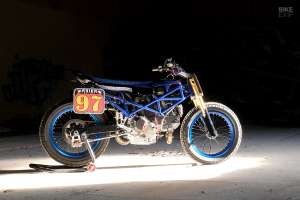
Reier Motors’ Rowdy Flat Tracker
Converting a 2001 Monster 900 i.e., into a flat track racer sounds like madness, but Christian Reier of Salzburg’s Reier Motors is a man obsessed with both dirt ovals and Ducatis. To get the stance right, Christian extended the swingarm to accommodate a 19-inch rear race wheel (laced to a KTM 1190 hub). The front end uses a Husqvarna hub and forks treated with blue titanium nitride coating for a factory-race look.
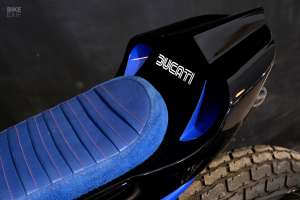
The ergonomics were radically altered with back-swept risers and ProTaper bars, designed to make the bike stable during high-speed drifts. Christian hand-fabricated the aluminum bodywork as a one-piece unit that can be removed with a few fasteners. The tail section subtly references the Ducati Panigale, giving this dirt-slinger a sophisticated superbike silhouette.
Mechanically, the bike was stripped of all non-essentials. The left foot peg had to be offset to clear the custom exhaust headers and Termignoni mufflers—a quirk that doesn’t matter on a track where you only turn left. Finished with a blue-and-red livery and safety-wired in all the right places, this is proof that the Monster can handle the “go fast, turn left” lifestyle with aplomb. [MORE]
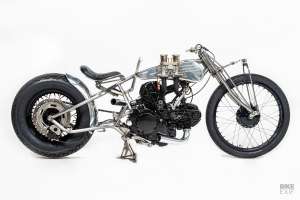
Machine 1867’s Impractical Hardtail
Edi Buffon of Machine 1867 specializes in “playful engineering,” and this Ducati-powered hardtail is one of his most over-the-top creations. Using a Monster 620 L-twin as a stressed member, Edi built a bespoke chromoly frame with a 38-degree neck angle. The front suspension is a custom leaf-spring design, a nod to early 20th-century board track racers, but re-engineered to handle the weight of a modern Italian engine.
The bike is a practice in “deliberate impracticality.” It features a right-side hand shifter, no front brakes, and a 15-inch rear wheel from a Triumph America paired with a 21-inch front motocross wheel. The intake system is a work of art, featuring a downdraught Weber carburetor with a copper fuel line and a brass pulley system to direct the throttle cable.
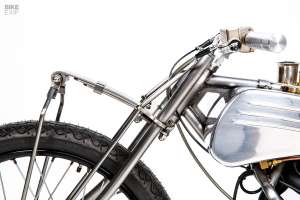
Visually, the bike is raw and mechanical. The frame was sanded and coated in clear Penetrol, while the split aluminum tanks (one for fuel, one for electronics) sit atop the backbone. With its trellis-style belt guards and obnoxiously loud short exhausts, Edi’s bobber is both elegant and complex—a build that captures the pure joy of custom fabrication without the burden of common sense. [MORE]
Walt Siegl’s Leggero Series
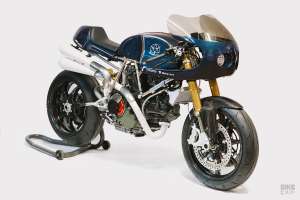
For Walt Siegl, customization is about distilling a motorcycle’s essence into its lightest, most potent form. This Leggero build, commissioned by Jamie Waters, centers around a 15-pound 4130 chromoly frame crafted in-house in New Hampshire. The motor, a Monster 1100 unit blueprinted and bumped to 1125cc by Bruce Meyers Performance, is a jewel featuring titanium valves and ported heads.
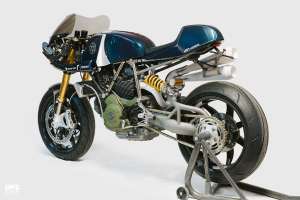
The chassis is a “who’s who” of performance parts: an S2R swingarm, Öhlins TTX rear shock, and BST carbon fiber wheels. Walt opted for a classic twin-headlight Kevlar fairing, which gives the bike a sophisticated European endurance racer vibe. The exhaust is a ceramic-coated stainless steel masterpiece, finished in white as a nod to the side pipes of early Shelby Cobras.
The paint is a Laguna Blue sampled from a 1966 Corvette in the owner’s collection. With gold pinstriping and a nickel-plated frame, the bike manages to look like a vintage muscle car and a cutting-edge Italian sportbike at the same time. It is a machine built by a rider, for a rider, where beauty is simply a byproduct of extreme performance. [MORE]
Earle Motors’ S4RS Track Brute
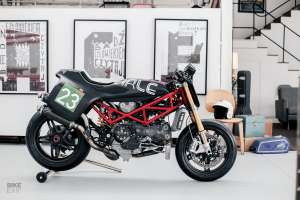
Ten years after he first shocked the scene with his carbon fiber monocoque Monster, Alex Earle of Earle Motors decided to revisit the design with a focus on pure track performance. He chose the 2007 Monster S4RS as the platform, taking advantage of its 130-hp Testastretta engine and factory-spec Öhlins and Brembo components.
The bodywork is monocoque with an integrated fuel cell and an aviation-style cap. It can be removed in minutes via four bolts, revealing a carbon fiber battery tray and inner fender. Alex deleted the airbox, allowing the L-twin to breathe through K&N filters housed within the monocoque’s nose. To shed even more weight, he added 17-inch BST carbon fiber wheels and twin Termignoni pipes.
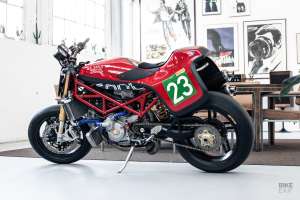
The livery is endurance-racing perfection: raw, satin carbon fiber on one side and glossy Ducati red on the other. With wide ProTaper bars and Rizoma rear sets, the ergonomics are designed for high-input track riding. Earle’s design was “street tracker” before the term was trendy, and a decade later, it still looks like the most aggressive way to lap a circuit on two wheels. [MORE]
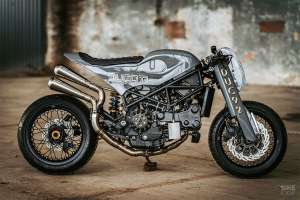
The Futuristic S4R by Moto Adonis
The S4R is a legendary “greatest hit,” packing a 113-hp 996 engine and a single-sided swingarm into a package that still embarrasses modern roadsters. Daan Borsje of the Dutch shop Moto Adonis decided to take this brute and push it into the future. Tasked by a client to build a “futuristic café racer,” Daan drew inspiration from an unlikely source: the organic, flowing lines of whales.
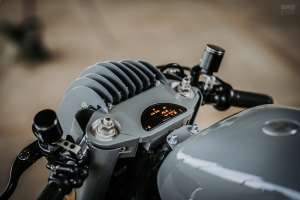
The most striking feature is the monocoque-style bodywork, which sweeps from the louvered headlight nacelle through the tank and into a sharp tail. To make this work, Daan reconfigured the upper frame and tucked the electronics—including a Motogadget m.unit blue—into a custom airbox and battery holder under the skin. The front end features a unique dual-lighting setup: a circular top light for dark roads and a strip light for urban prowling.
Underneath the Audi Nardo Grey paint, the mechanicals are top-tier. The bike rolls on Kineo spoked rims and stops via Moto-Master wave discs. The pièce de résistance is the custom MAD Exhaust system, which snakes around the L-twin engine like a coiled serpent. Dubbed “DUC92” as a nod to the Monster’s birth year, this build proves that the S4R’s bones are timeless, even when wrapped in the avant-garde. [MORE]