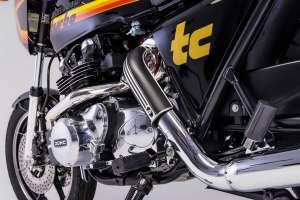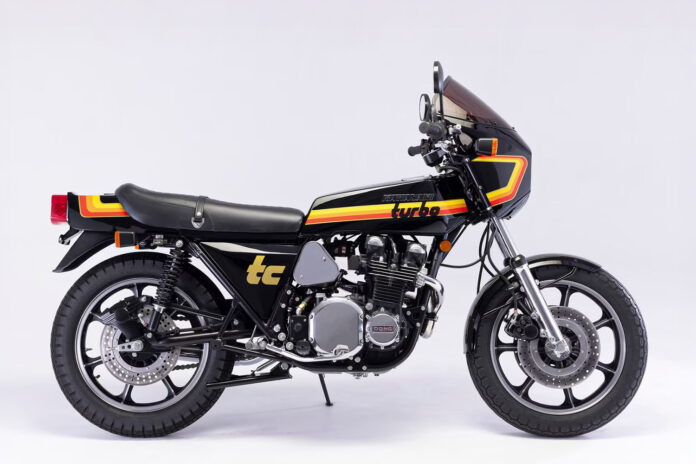
Few motorcycles capture the sheer recklessness of late-1970s performance culture quite like the Kawasaki Z1-R Turbo. Born at a moment when horsepower wars were escalating faster than brakes, handling and emissions laws could keep up, the Z1-R TC arrived through a uniquely American workaround. Conceived as a partnership to restore Kawasaki’s crown in the horsepower wars, a mere 519 examples were modified by the Turbo Cycle Corporation before being shipped to dealerships, making the Z1-R TC the first turbocharged motorcycle ever offered on a showroom floor.
Explaining how we got here takes a brief dive into ’70s Japanese motorcycle history, but the dip is worthwhile. Cast your mind back to 1969. Recognizing that civilized four-cylinder, four-stroke bikes were the way of the future, Kawasaki put its beloved 750 two-stroke to bed and developed a 750 four-cylinder in secret—but Honda’s CB750 beat them to the punch.
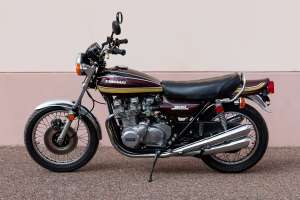
Fearing the worst in a fair fight, Team Green went back to the drawing board, developing the world-beating, 903 cc Z1 in 1972, and Kawasaki would go on to rule the roost until 1977. But that’s when it all went wrong. Yamaha dropped the XS 1100, Honda debuted the six-cylinder CBX and Suzuki clapped back with the GS1000.
Now fourth in effective real-world performance, it was clear the Kawis wouldn’t be hot sellers in the near future, making the Team Green brass amenable to most any idea. The solution came from a man named Alan Masek. Masek had been instrumental in helping Kawasaki develop its American dealer network for more than a decade before he started his own venture—the Turbo Cycle Corporation (TCC)—which was one of the few firms selling motorcycle turbo kits in those days. With boost, Masek believed that Team Green would be the stoplight king once again, and Kawasaki execs went along with the idea—serving up fresh ’78 Z1-Rs for modification.
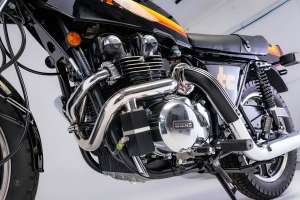
In a small Southern California workshop, TCC installed the forced-induction components developed with the help of American Turbo-Pak. Rajay F40 turbochargers were grafted to the DOHC 1,016 cc four, plumbed in a draw-through Bendix pumper carb fed by a fuel pump. The stock headers were tossed in favor of hand-welded turbo manifolds with an adjustable wastegate set between 6 and 10 psi.
TCC deemed the engine safe at these levels, and while that seems pretty tame, it was enough to catapult the Z1’s peak power from 81 to 126 hp. On paper, the Z1-R TC was the fastest thing on the streets, which must have felt like a godsend to the brass at Kawasaki, but even so, they were smart enough to handle the fine print. To start, Kawasaki didn’t recognize the Z1-R TC as an official model, but instead, a modified Z1-R available in the showroom. That was enough to keep the EPA off its heels. There was also no warranty, and you had to sign a waiver before forking over your $5,000 (around $25,000 in today’s money).
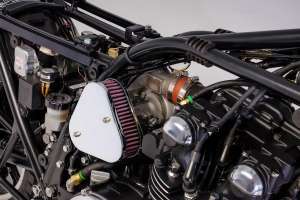
So, what was the riding experience like for those power-crazy fools who purchased a Z1-R TC new? In short, nothing short of mental. Other than the forced induction components, this was a stock bike, and the Kawasaki’s frame was barely up to the task of handling the stock engine. While it would be easy to critique the braking performance nearly 50 years later, the Z1-R’s dual-disc front and single-disc rear would have been considered some of the best equipment available. That being said, we are talking about late ’70s tire technology. And that’s all before we touch on the hair-trigger performance of the Rajay F40 windmaker.
If there’s a common theme for early endeavors in boost, it’s turbo lag, and the Z1-R TC’s turbo was too large for the application. The bike was actually slower until around 4,500 rpm when the turbo spooled, and then it rolled on like a kick in the ass. Peak power hit at around 7k, and you had better have your wits about you to shift gears before the 8,500 rpm redline, or you’d have expensive problems on your hands.
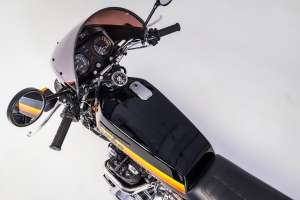
But there’s no denying that this thing went like stink. If you could manage the power, the Z1-R TC was the fastest ‘stock’ bike on pavement, with acceleration in a league of its own. It would do the quarter mile in around 10.85 at speeds over 130 mph, and more boost could be had with a turn of a screwdriver. TCC originally instructed that boost shouldn’t exceed 10 psi, but this number was lowered multiple times afterward to improve reliability.
They probably should have used the word ‘longevity’ instead, because the Rajay F40 had a tendency to expose the Z1-R’s weaknesses. The crankshaft was in no way up to the task, even at approved boost levels, and you were certain to twist it out of phase if you rode it hard for long enough. It was also easy to over-rev with the way the boost came on, which could be catastrophic for the top end, and wearing out the clutch wasn’t an ‘if,’ but a ‘when.’ Not to mention the turbo’s tendency to suck the sump dry.
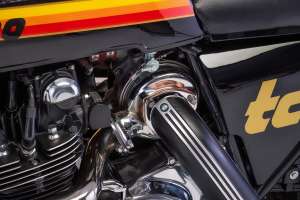
While there was no dismissing the bike’s superior acceleration, the motorcycling press of the day aptly pointed out that the Z1-R TC was flawed by nature. It was a light switch, on or off, meaning that it was underwhelming under 4,500 rpm, and unmanageable above. Even so, stats spoke to the hot heads at the ragged edge of the performance segment, and it’s estimated that around 250 Z1-R TCs were sold in 1978 and around 250 in 1979.
Alright, so these bikes (while certifiably badass) were obviously flawed and unwieldy, but it makes you wonder why this didn’t catch on. The truth of the matter is quite boring. Motorcycles like the Kawasaki Z1‑R TC were exciting technological showcases, but they never caught on with the broader market. Turbo lag made power delivery unpredictable for everyday riders, maintenance was complex and expensive, and the bikes were costly compared with naturally aspirated machines offering similar performance. Additionally, the rapid development of high‑output four‑cylinder engines in the late ’70s and early ’80s meant riders could get thrilling speed and acceleration without the compromises of forced induction. As a result, turbos remained niche curiosities rather than mainstream motorcycles.
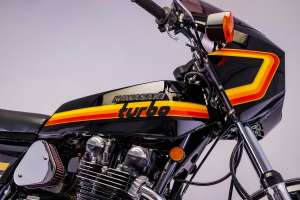
While I love a good deep dive into the weird footnotes of motorcycle history, we all have to come back to the surface for the point of the matter. And that is that YOU could be the proud owner of one of these hair-trigger machines if your pockets are deep enough. Mecum will be hammering away 2,000 bikes January 27-31, 2026, but as far as I’m concerned, there’s just one that would look right in my living room.
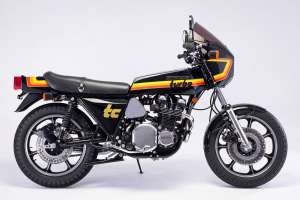
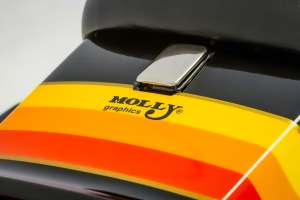
No surprise, it’s this 1978 Kawasaki Z1-R TC—a desirable first-year example that’s been nut-and-bolt restored to literal perfection—and (most importantly) the engine’s been rebuilt from the crank up. It’s also the shit-hot ‘Molly’ colorway, as opposed to the Stardust Metallic, but that may not be correct.
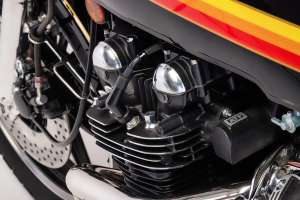
Typically, ’78s are finished in Stardust Metallic, while the ’79s wore the Molly paintwork, but we’re talking about poorly documented history from 50 years ago. This machine could have been a late ’78 build, it could have been repainted by the dealer, or someone made a decision to deviate from stock during the restoration. There’s no way of knowing for sure. All I know is that it’s perfect and I love it.
Don’t expect it to go cheap, though, as the market has placed a premium on these bikes, given their historical significance and outlandishness. While average examples can be found in the middle $20k range, the best restored examples can fetch just short of $40,000. My estimate for Lot R604 is $32,000 to $35,000.
It’ll be crossing the block on Friday, January 30th, at Mecum’s Las Vegas 2026 sale, and if the lucky new owner is reading this, I am truly envious.