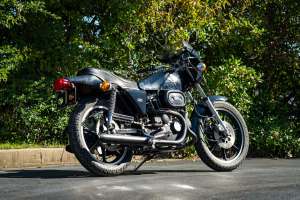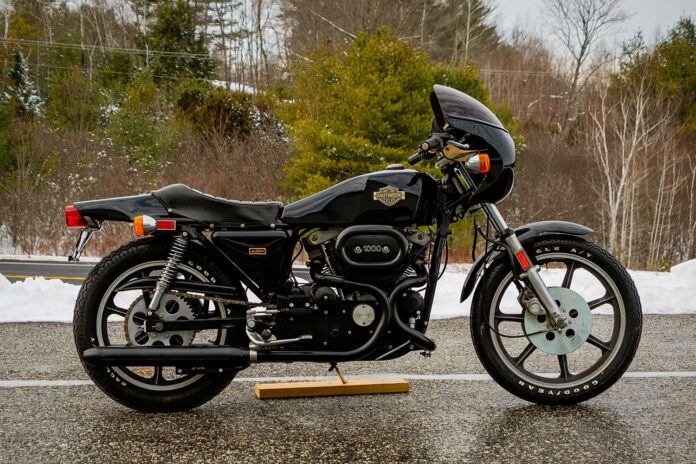
The 1977 Harley-Davidson XLCR is often described as a failure, which is technically correct and intellectually lazy. It didn’t sell well, it confused the dealer network and it landed with a thud in a marketplace already dominated by faster, cheaper, more technically advanced motorcycles from Japan and Europe. But the XLCR wasn’t a bad motorcycle so much as a culturally premature one. It arrived at a time when Harley was still down on its luck, before the company had the institutional muscle to explain what the XLCR was trying to be, and before it had the audience to appreciate a mid-size cruiser with an aggressive image.
To understand the XLCR, you have to forget the mythology that’s been retroactively applied to it. This was not Harley trying to build a Ducati. It wasn’t an XR750 with lights. Perhaps the biggest mistake was in the name alone—CR designating café racer— since it wasn’t even a proper café in the British sense. The XLCR was something far stranger: a styling-led experiment that attempted to reconcile Harley’s torque-first V-twin ethos with the visual grammar of European sport bikes—and to do so inside a company that had never needed to think that way before.
Willie G.’s Black Sheep
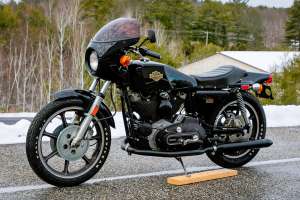
The XLCR was very much Willie G. Davidson’s project. Third-generation HD royalty, Willie joined the design department in 1963 and became the Vice President of Styling in 1969. Willie lived the life, with many of his own modified bikes becoming the inspiration for Harley’s dicier models. While they weren’t always hits in period, iconic HD designs like the ’71 FX Super Glide, ’77 FXS Low Rider and the ’77 XLCR were thanks to Willie. Designed in collaboration with HD engineer Bob Modero, Jim Haubert Engineering and Dean Wixom, the XLCR would be his most radical styling exercise yet.
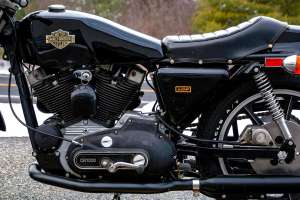
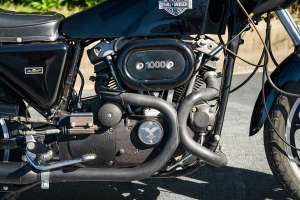
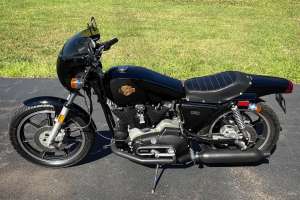
While it’s undoubtedly a Sportster underneath, the bike was more than a sheep in wolf’s clothing. The chassis made use of the XR’s rectangular swingarm, the wheels were Morris Mags and the brakes were dual discs up front and a single disc rear. The exhaust was unlike anything seen on an HD before, consisting of a pair of siamesed headers with full-length pipes on each side of the bike—finished in matte black.
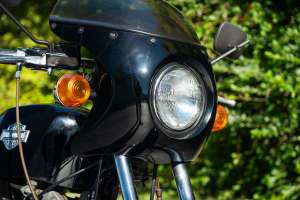
The influence of the XR750 is unmistakable, but not in the way people often claim. The XLCR borrowed the visual authority of the XR—the solo seat, the squared-off tail, the no-nonsense stance—without inheriting its singular purpose. This wasn’t a race bike. It wasn’t even pretending to be one. The tank echoed the XR’s image, but with a practical 4-gallon capacity, and the solo seat was a sofa in comparison to the real-deal flat trackers. It stripped away chrome, leaned hard into blacked-out finishes and presented a narrow, purposeful silhouette that looked nothing like the Electra Glides and FX models filling Harley showrooms.
The Mechanical Reality Check
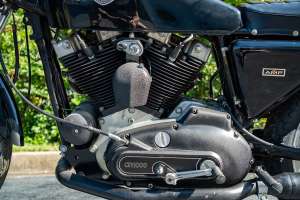
Strip away the aesthetics and the XLCR was, at heart, still an Ironhead Sportster. The 998 cc V-twin was nominally the most powerful engine Harley offered at the time, but that’s damning with faint praise. Depending on whose dyno you trust, output was between 60 and 68 horsepower. Torque was healthy, as expected, but the rev ceiling was low and the vibration ever-present.
While slightly flawed by nature, the Ironhead would deliver rewarding performance if treated right. Mid-range grunt made it wholly unnecessary to ring the tach above 5,000 rpm, and the engine would return quarter-mile times in the high 12s to low 13s. Top-speed reports from the day vary between 110 and 120. That’s not too far off the mark for 1977, right in line with the CB750, which is admirable considering the wildly different characteristics of those two powerplants.
Contemporary road tests were polite but unconvinced. Reviewers admired the look, praised the stability at speed and noted that Harley’s first serious attempt at a sport-leaning road bike wasn’t without merit. But the handling was heavy, the steering slow and the suspension struggled once the pace picked up. The front disc brake was an improvement over earlier Harley efforts, but it still lagged behind the dual-disc setups becoming common on Japanese machines.
And that’s the crux of it: the XLCR was never bad enough to dismiss, but never good enough to defend on merit alone. Against a BMW R90S, a Moto Guzzi Le Mans or a Suzuki GS1000, it simply couldn’t compete dynamically. Harley hadn’t yet learned how to engineer a sporting chassis, and the market had already moved on from forgiving enthusiasm in favor of measurable performance.
A Bike Without a Buyer
The XLCR’s commercial failure wasn’t just about numbers—it was about identity. The majority of Harley’s traditional customers didn’t want it. The riding position was too aggressive, the aesthetics too austere, the purpose unclear. Meanwhile, sport riders looked at the spec sheet and kept walking. Why buy a Harley café racer when you could have a smoother, faster, better-braking four for less money?

Dealers didn’t know how to sell it either. Harley dealerships in the late ’70s were not lifestyle boutiques; they were relationship-driven, conservative places that sold what they understood. The XLCR required explanation. It required context. Harley wasn’t prepared to provide either.
So the bikes sat. Roughly 1,900 were built in 1977, followed by about 1,200 in 1978. A handful dribbled into 1979 as leftovers. For a major manufacturer, that’s a rounding error. The XLCR quietly disappeared, and Harley retreated back to safer ground.
Riding One Today
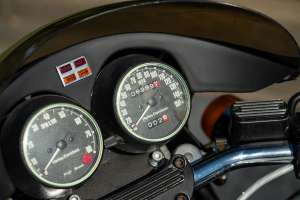
Here’s the uncomfortable truth: riding an XLCR today doesn’t suddenly vindicate it. By modern standards it’s slow, heavy and crude. The clutch is agricultural, the gearbox demands authority and the engine communicates everything it’s doing, whether you want it to or not. It doesn’t flatter the rider. It doesn’t forgive mistakes.
But that’s also why it works now in a way it didn’t then.
The XLCR makes sense as an object, as a deliberate expression of intent rather than a performance tool. It looks just as good as it did in 1977, but for different reasons today. It seems like no other Sporty you’ve seen. It’s purposeful, sinister and the physical embodiment of what badass meant in the late ’70s.
Legacy: The Café Racer Harley Never Repeated
The XLCR didn’t lead to a lineage. There was no sequel, no refinement, no second chance. Harley wouldn’t attempt anything this overtly sport-leaning again until the XR1200, and even that arrived with a heavy dose of compromise. In hindsight, the XLCR looks less like a failure and more like an early probe—a question asked too soon, in a language the audience didn’t yet speak.
Today, the XLCR occupies a rarefied space. It’s collectible not because it was great, but because it was different. It represents a moment when Harley-Davidson briefly looked outward, tried to engage with global motorcycle culture and then recoiled when the response was confusion. The XLCR wasn’t wrong. It was early. And in motorcycling, being early can be worse than being wrong.
Current Valuation
Given the bike’s footnote status in Harley history (and the scant production figures), XLCRs are hardly the most common old HDs seen at auction, but every once in a while, someone wheels an OG example out of some shed. You’ll have four separate chances to bag this iconic Sporty at Mecum’s massive upcoming Las Vegas 2026 auction, each with its own merit.
Lot F291 is a desirable first-year model that’s been comprehensively restored, leaving nothing to be desired. However, if originality is your thing, my choice is Lot S74. While S74 is a second-year ’78 model, its appearance is as original as they come. It’s still wearing old Goodyear Eagle A/T rubber, and the wrinkle-coat case covers have just enough patina to call original (except for the clutch side). With 9,600 miles on the odometer, it’s probably safe to assume it’s been cared for, but still has a few stories from the bad old days.
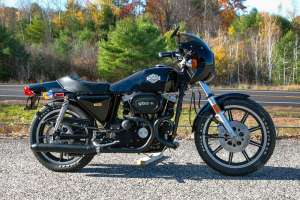
For my money, it’s Lot S320, though, because that’s the rider-quality bike of the group. Because if you’re anything like me, this is a machine to be seen on. Either way, we’re probably talking about $15,000 to $18,000 across the board for any of these XLCRs, which seems like awfully strong money for a bike that you’d call misunderstood at best.
For me, the Harley-Davidson XLCR is pure ’80s Americana. It’s metal, it’s Van Halen, or the Iron Horse Motörhead was referencing, and I couldn’t give a damn whether it was considered a ‘good bike’ or not. I guess you have to chalk it up to mystique. [Mecum]