Kork Ballington occupies a rare space in Grand Prix history, the kind reserved for riders who combined speed with mechanical sympathy and timing that bordered on prophetic. Born in Rhodesia and racing under the South African flag, Ballington arrived in Europe during a period when Grand Prix paddocks were still rough-edged and brutally competitive. He wasn’t groomed by a factory from the outset. He earned his way in through grit, adaptability and an uncanny ability to extract results from machinery that was often still finding its footing.
That ability caught the attention of Kawasaki at exactly the right moment. In the late 1970s, the Japanese manufacturer was aggressively rebuilding its Grand Prix program, determined to take the fight to Yamaha and Suzuki in the two-stroke era. Ballington became a cornerstone of that effort, delivering Kawasaki its first 250 cc and 350 cc World Championships in 1978 and repeating the double in 1979. Those titles didn’t just validate Kawasaki’s racing ambitions; they established Ballington as one of the most complete riders of his generation.
By the early 1980s, the 500 cc class had become a different kind of war. Yamaha’s OW series and Suzuki’s RG500 had set the benchmark, while Honda was preparing its four-stroke counterpunch. Kawasaki’s KR500 square-four was fast but notoriously difficult, demanding absolute commitment from anyone brave enough to ride it at the limit. Ballington, now a veteran with factory trust, took on the challenge in 1980 with a measured, cerebral approach that contrasted sharply with the bike’s reputation.
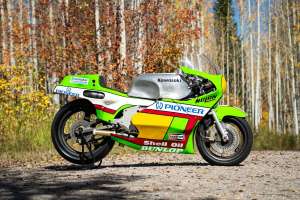
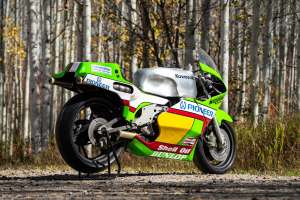
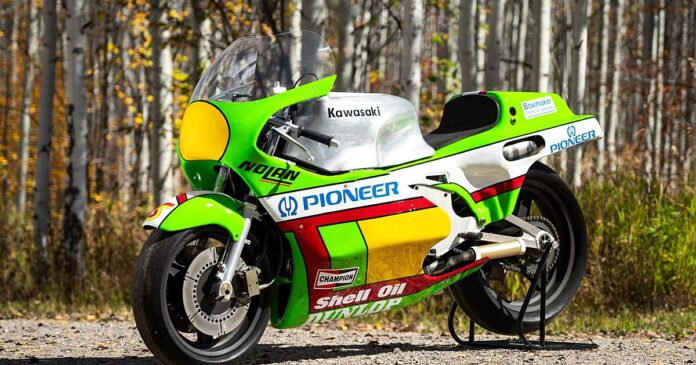
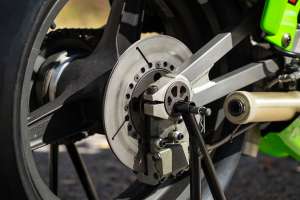
Described as a ‘masterpiece of engineering,’ the KR500 employed some radical design elements from the mind of Kinuo Hiramatsu. The chassis sidestepped the norm, constructed in an aluminum monocoque design with a built-in fuel tank. It was incredibly stiff, but unforgiving at the limit. A removable magnesium head angle plate was incorporated at the front, allowing the rake to be quickly adjusted. The front and rear suspension also featured eccentric mounts to further fine-tune its handling. Magnesium, titanium, carbon fiber and aluminum were used throughout, with the alloy fuel cell being custom-fit to each rider.
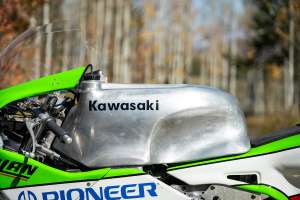
Hanging below the monocoque was an equally unique engine: a liquid-cooled, 498 cc square-four two-stroke that owed more to aircraft thinking than production motorcycles. Effectively two parallel twins geared together through a central gear train, the KR500’s layout allowed Kawasaki to keep the engine short front-to-back while maintaining ideal crankshaft phasing and scavenging characteristics. Each crank served a pair of cylinders, with rotary disc valves controlling intake timing—an arrangement that delivered razor-sharp throttle response and exceptional peak breathing at the expense of complexity and setup sensitivity.
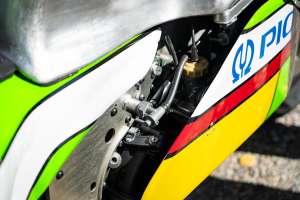
Power was quoted at roughly 120 horsepower at around 11,000 rpm, an extraordinary figure for the time, but it came wrapped in a notoriously narrow powerband that demanded precision from the rider. Depending on the setup, speeds of 180 mph were achievable.
While Kawasaki threw the entire engineering toolbox into its design, the KR500 would fall victim to economic circumstances from the outset. The bikes were built in incredibly small numbers, with each differing slightly from its stablemates. With resources strained by management, there was almost no pre-season testing to optimize the latest design revisions, and the bugs often needed to be sorted out at the race track.
Kawasaki’s radical KR500 debuted in the 1980 500 cc World Championship at the Nations Grand Prix on the Misano circuit with four-time world champion Kork Ballington aboard. Despite high hopes, the machine was still a work in progress and struggled to match the established two-stroke fours from Yamaha and Suzuki. Ballington’s best results were occasional top-ten finishes, and he ended the season 12th in the world championship standings, reflecting both the promise and the teething issues of Kawasaki’s ambitious newcomer. The KR500’s handling was compromised by its length and weight relative to competitors, and though its engine was competitive, the package lacked the refinement needed to consistently challenge for podiums.
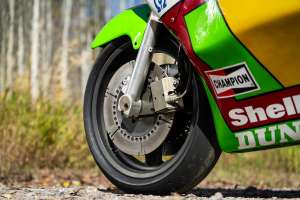
Kawasaki soldiered on with significant upgrades for 1981, introducing a lighter, stiffer chassis, magnesium crankcase and anti-dive front suspension. Those improvements helped Ballington score the bike’s first World Championship podiums, third places at both the Dutch TT and the Finnish Grand Prix, and he concluded the season eighth overall, the best championship result for the KR500 in GP competition.
For 1982, further changes included a switch to Showa suspension, and while the bike was more competitive and Ballington scored multiple top-ten finishes with a best result of sixth at Misano, he slipped to ninth in the championship. Where Kawasaki found the most success that year was on home soil: Ballington dominated the ACU 500 cc British Championship with six consecutive victories, capturing the title and underscoring the KR500’s potential in national competition even as world championship wins continued to elude the factory effort.
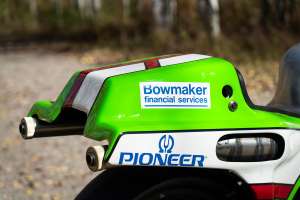
Unable to recreate earlier successes in the smaller cc classes, Kawasaki withdrew from Grand Prix racing after ’82. Three of the four surviving KRs found permanent homes among Kawasaki’s global network, while Ballington was able to acquire the fourth, later sold to a collector in France. At that time, Ballington mused that his KR was likely the only example that wasn’t under lock and key with Kawasaki, but Lot S231 in Mecum’s upcoming Las Vegas 2026 auction begs to differ.
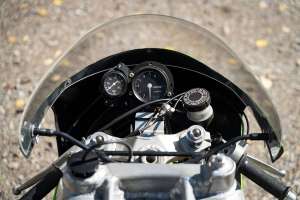
The bike in question is explicitly described as a replica, having been modeled after Kork Ballington’s 1982 Grand Prix bike, but by all available accounts, it is (in fact) a genuine 1982 KR500. One of the remaining three, this example is stamped No. 82-02, making it the second KR500 racer built that year, while Ballington’s bike is No. 82-03. Furthermore, the accompanying documentation asserts that the bike was ridden by Ballington at one time and was later rebuilt in the style of his ’82 championship machine. The ink isn’t always worth the paper it’s printed on, but when that documentation comes from the prolific collector George Beale, you can rest assured writing the check.

What it will sell for is anyone’s guess, because how in the hell would you come up with any comps? It’s certainly a rare machine, being one of four built, and the connection to Ballington comes on good authority, but what does it add value-wise since it’s not documented as the 1982 championship machine?
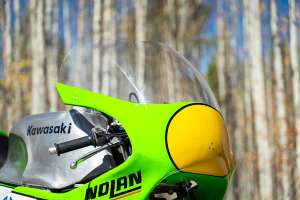
In my opinion, the value comes not from the paperwork attached, but from the article itself. The pedigree is evident in every weld, every custom-machined and hand-formed component and the presence of the sum of those parts. While we (and surely Kork himself) wish the 1982 KR500 had more championship notoriety, it’s still somehow the perfect physical embodiment of an era of GP racing. An era when the manufacturers were still willing to try new ideas, and the racers had the grit to make miracles.
Lot S231 will cross the block on Saturday, January 31st, as part of Mecum’s Las Vegas Motorcycle auction, and should you miss it, another 2,000 bikes will be there vying for your attention.