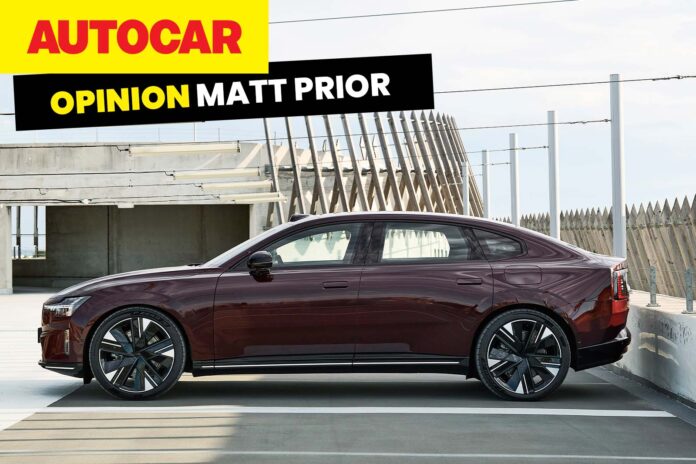
And so to the Volvo ES90, the big electric saloon car from the famous maker of big sensible family saloons, estates and SUVs. By gum, it’s a striking-looking thing, isn’t it?
There’s lots of dynamism on show. In profile it looks not unlike a Polestar 2, or wait, is that a 4, or a 5? One of them that isn’t an SUV. Not that any of them is really an SUV, but I’m sure one – is it the 3? – is at least a tall estate. Not quite an estate, but close. Oh, look, I don’t know.
What I do know is that the big new Volvo is electric, and also looks a bit like a car from that car maker nobody had heard of four years ago, but which I’m sure is related, somehow. Something to do with the Chinese?
Anyway, loads are 80 grand and, give or take, five metres long and all sprint faster than a dachshund who’s spotted a squirrel. Though I read in the news that nobody’s really buying them except on grand-and-a-bit-per-month company car deals, and that there aren’t enough of those to go around.
It’s a pickle, isn’t it? Some car makers are lobbying European regulators to say that we’ve got the forecasts wrong on moving to full electrification by 2035, that modest sales of big electric cars shows this, and that the only winner if we don’t think again will be the Chinese car industry.
Then there are others who have bet so much on electrification that they’re in an equally big muddle if the rules are relaxed. I don’t know what Polestar says about it, but I think this is where it sits, as an all-new, all-electric brand confidently created knowing that everyone will be buying battery vehicles soon because they’ll have to; and that designing them in Sweden, where it’s stylish, but making them in China, where it’s cheap, was a good idea.
But was it? Because if Polestar does need to pivot a bit, how can it? To a greater or lesser extent, Volkswagen (ID), Mercedes-Benz (EQ) and others have gone down this route, creating sort-of stand-alone electric brands in the hope that customers will jump aboard.
The usual lesson, I fear, applies here: customers often don’t care about brands. They don’t give them a second thought and have no idea what an ID or an EQ is, and they’d only have half an inclination to find out even if it wasn’t for parents’ evening tonight, the gas bill coming through, whether it was Saturday or Sunday we were going to visit Barry and why has the dishwasher stopped working? In this context, a Volkswagen IDwhatnow?
But where in VW’s and Mercedes’ cases the new branding hasn’t really caught on, it’s relatively easy to undo: Volkswagen can just call the ID 2 a Polo instead and still has combusted Golfs to sell, and those are names we’ve known since we were children. So for car makers with sub-brands whose ICE/part-ICE cars will lift heavier for longer than expected, it’s inconvenient.
But if one’s whole shtick is being a new electric brand – which has necessitated new design and engineering teams, factories, distribution networks, marketing and advertising departments and a host of other back-end teams separate from the mothership – what happens if a rejig is needed? I’m reminded of when BMW introduced the 5 Series GT at around the same time (I think) as the X1.

