The annual Yokohama Hot Rod Custom Show is poised to unleash a flurry of visual delights when it opens its doors to the public tomorrow. Colloquially known as Mooneyes, it’s not only Japan’s top show but also arguably one of the most prestigious in the world. So if you’re planning to unveil your latest build there, it had better be good.
Custom Works Zon founder, Yuichi Yoshizawa, and his right-hand man, Yoshikazu Ueda, are regular faces at Mooneyes with multiple trophies to their names. But this year’s CW Zon entry might be the shop’s wildest yet. It’s based on a Royal Enfield Classic 650—or, more accurately, two of them.
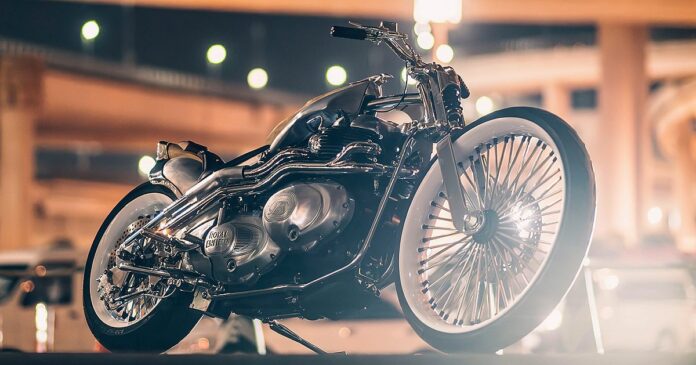
“Most custom motorcycles showcased at HRCS are powered by large-displacement engines,” says Yoshizawa-san, “and the engine’s visual impact is always a crucial element. The Classic 650 engine is beautiful, powerful, and full of character—but I wanted to elevate its presence even further. That’s how I arrived at the idea of using two engines.”
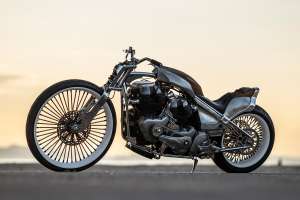
A twin-engine build is always an ambitious endeavor, but Yuichi had a specific vision for the build that would add an extra layer of complexity. Where most twin-engine bikes are typically stretched land-speed racers, he wanted something closer to the proportions of a chopper.
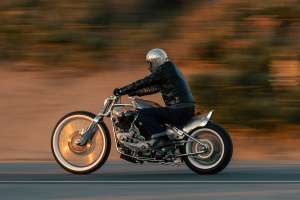
“Land-speed racing feels somewhat distant from the mainstream custom motorcycle culture in Japan,” he tells us. “Choppers, on the other hand, are extremely popular. Debuting a dual-engine chopper would create a much stronger reaction—and personally, I have always loved choppers.”
The Royal Enfield Classic 650’s parallel-twin motor is an elegant piece of machinery, but Yuichi knew that if he placed one perfectly in front of the other, the overall size would be unavoidable. So he had an idea: What if he could offset the height of one of them?
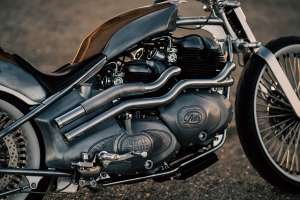
“The front engine didn’t require a gearbox,” he explains. “So by separating the transmission section and trimming the crankcase, I could position it closer to the rear engine, which retained its gearbox. By staggering their height, I reduced the distance between the two units even more—achieving the powerful presence of a dual-engine machine while keeping the overall chassis compact.”
CW Zon has experience modifying the crankcases and cylinder heads of vintage bikes, so this part of the job wasn’t too stressful. The big challenge was figuring out a way to connect the two motors mechanically. The guys ended up using a custom-made extension for the front motor’s crankshaft, and then adding a primary gear and chain to link everything up.
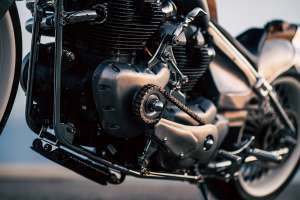
“It sounds simple when explained now,” Yuichi says, “but reaching that solution required a lot of trial and error. We discovered that the extension shaft for the front engine must use a left-hand thread, and the rear a right-hand thread. The chain line of the two primary gears also had to be perfectly aligned and maintained during engine mounting, which demanded high manufacturing precision when building the engine mounts.”
“To place the engines as close as possible, clearance between the front engine’s throttle body and the rear engine’s exhaust pipe was reduced to a minimum. Positioning that correctly, along with the fabrication of the exhaust system, was another challenge. Synchronizing the two engines was easier than expected—a single ECU manages both. Thanks to the modern engine platform, achieving synchronization was remarkably straightforward.”
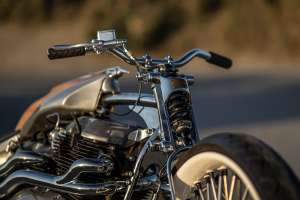
The four-cylinder drivetrain only tells part of the story, though. With such a unique engine in play, the stock Classic 650 frame was no longer adequate. CW Zon fabricated a new hardtail frame instead, along with a bespoke girder front end.
Both the frame and fork were imbued with a sense of elegance. The girder arms were made from 12 mm steel plates that were bent before being carved by hand. The frame’s main backbone was built as much for strength as it was for style, and the lower rails were designed to be detachable to make the engines easier to remove and reinstall.
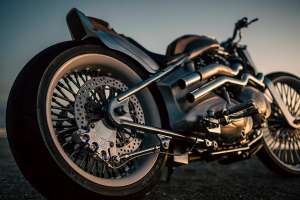
Next, the Royal Enfield was propped up on 26F/18R wheels, equipped with Performance Machine brake calipers, Hot Dock discs, and Neo Factory master cylinders. With the rolling chassis sorted, the crew switched focus to the new bodywork and myriad handmade details.
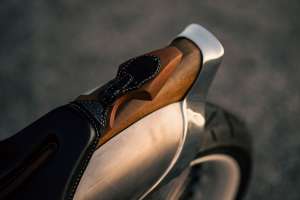
An aluminum fuel reservoir was built and mounted under the seat, while the space where a tank would traditionally sit was filled with a box that houses key electronic components. A friend of Yuichi’s and experienced furniture maker, Hanafusa Heritage Carving, helped add beautiful mahogany trim to the bike, while Kuureiyonsoku took care of the masterful leatherwork. Yuichi finished the bodywork off with a sculpted aluminum adornment that resembles a bird in flight.
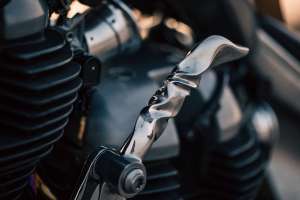
“To celebrate the raw character of each material—steel, aluminum, and wood—I left all the exterior parts unpainted,” he adds. “The jockey shifter is hand-forged Damascus steel. I personally learned forging techniques by visiting a Japanese swordsmith’s workshop, acquiring a furnace and hammer, and forging the piece myself.”
“The bike’s name, Vita, comes from the Latin word for ‘life.’ Through the bird sculpture, and through the expressive qualities of steel, aluminum, and wood, I wanted to convey a sense of vibrant life and raw energy.”
CW Zon | Facebook | Instagram | Images by Hiromitsu Yasui