Advanced driver assistance systems (ADAS) continue to
develop.
Software defined vehicles herald a new age of mobility.
Advancements in connected vehicle technology and over the air
updates drive this shift, with Level 3 automation another milestone
toward fully autonomous vehicles.
Software defined vehicles(SDVs) are revolutionizing the driving
experience. The trifecta of autonomous driving with capabilities
and over the air updates enhances vehicles' operability and
functionality. How can OEMs and suppliers capitalize? More
importantly, what role will they play in autonomous driving?
The Evolution of Autonomous Driving
Automotive manufacturers have offered relatively simple Level 2
systems for more than a decade, but it was the advent of Level 2+
that really moved the industry from Advanced Drive Assistance
Systems (ADAS) to Automated Driving. By integrating advanced
sensors and vehicle software into a more holistic system design,
L2+ vehicles from Tesla to Cadillac could achieve new functionality
combining steering and acceleration and more—but this partial
automation still requires the driver to remain engaged. Today, BMW,
Mercedes, and more are joined by a host of tech-forward Chinese
brands from NIO to Huawei that are actively developing Level 3
autonomous vehicles to manage more complex driving scenarios and to
relieve the driver of constant supervision.
While the vast majority of the industry is focused on L2+ and
some on L3, Levels 4 and 5 automation, i.e., fully self driving
cars, remain a long-term industry goal and a near-term focus for a
select few. If fully developed and safely implemented, the
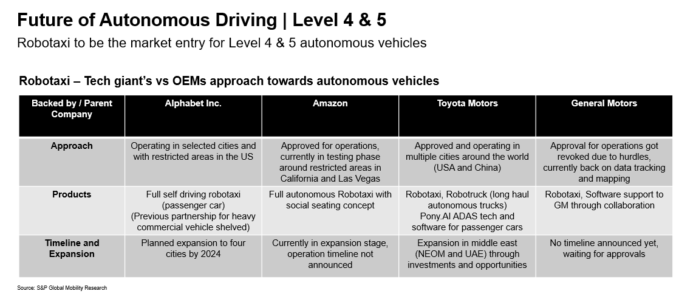
technology's potential is tantalizing. Tech giants like Alphabet's
Google and Amazon are backing innovative startups such as Waymo and
Zoox to push the boundaries of Level 4 autonomy. At this level,
vehicles are fully autonomous and operate independently in
geofenced areas. They integrate advanced software—evolving from
machine learning algorithms to full stack training using Large
Visual Models—with the latest sensor technologies to navigate
without human input. The industry envisions a future where cars are
not just vehicles but sophisticated mobility solutions—for
instance, driverless car technology such as robo-taxis navigating
city streets and transporting passengers without human
intervention
The Impact of Advanced Driver Assistance Systems (ADAS)
Across the industry, Advanced Driver Assistance Systems (ADAS)
are rapidly developing in both safety and driving efficiency.
System capabilities like hands-free driving cars with the support
of Driver Facial Monitoring systems are increasingly sophisticated.
Tesla, a leader in this field, has improved its software to handle
dense urban driving and intersections as well as more traditional
highway cruising functions that are the early focus of other.
The Role of Over the Air Updates in Modern Vehicles
Another transformative aspect of software defined vehicles is
the ability to improve and upgrade continuously through remote over
the air updates. Automotive manufacturers can update software, fix
bugs, enhance functionalities, and even add new features without
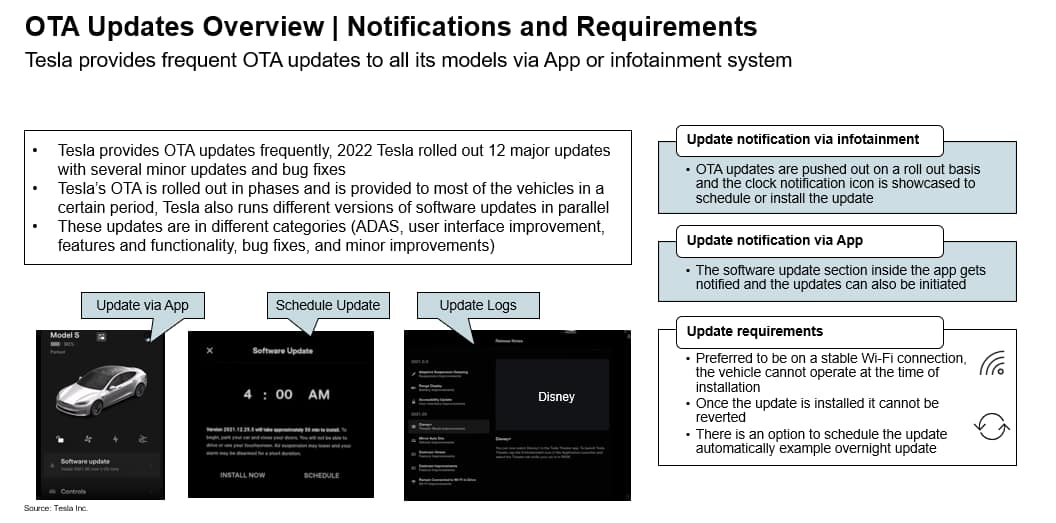
requiring physical modifications to the vehicle. Tesla delivers
frequent updates in select groups of vehicles in phases through the
infotainment or app. This approach has caught on with other
automotive manufacturers like Rivian, which adopt similar
strategies.
The new age EV automotive manufacturers focus on vertical
integration and advanced technology that gives them the advantage
of systems compatibility. Integrating over the air updates comes
with challenges. Managing software across various hardware
components, often from different suppliers, requires a
sophisticated coordination and testing process to ensure
compatibility and performance. Despite this, the benefits of over
the air updates are immense. It eases the burden of recalls and
enables automotive manufacturers to swiftly respond to user
feedback and emerging technologies, while also opening up a new
revenue stream.
Importance of Software Architecture in Software Defined
Vehicles
As vehicles become more software-centric, the connected vehicle
technologyis increasingly critical. Connected vehicle technology
refers to integrating advanced communication and information
systems within vehicles. They enhance vehicle functionality by
providing safety features, entertainment options, and real-time
diagnostics. The industry's push towards using telematics and
vehicle-to-everything (V2X) communication enables vehicles to
interact with the city infrastructure and other vehicles to enhance
road safety and traffic management.
Efficiencies in software architecture are necessary to support
modern cars' growing interconnectivity and advanced
functionalities. Developing this standardized architecture is a
crucial priority for automotive manufacturers and suppliers.
Investments and strategic partnerships from chipmaker Qualcomm and
software giant Microsoft, will improve on connected vehicle
technology by defining digital cockpit, providing advanced systems
enabled by gen AI and equipped with latest sets of connect features
and advanced driver assistance systems for the industry.
Challenges in Global Autonomous Vehicles Adoption
Despite theseadvanced driver assistance systems, there are
obstacles to widespread adoption of autonomous vehicles.
Legislation and infrastructure vary significantly across different
regions, creating a patchwork of regulations that automotive
manufacturers must navigate carefully. Deployment of Level 3 and
Level 4 vehicles will be extremely localized so the fragmented
regulatory landscape and harmonization across global markets is a
challenge but it's not a non-starter. Vehicle-based perception and
planning is also being developed to be infrastructure-agnostic, but
connectivity and network coverage do represent more headwinds,
especially as automotive manufacturers seek to achieve global scale
and simpler supply chains.
The shift towards software defined vehicles is one enabler of
growing vehicle autonomy and increased connectivity. OEM, supplier,
and industry innovations will redefine our relationship with cars,
making them more adaptable, safer, and more attuned to the needs of
their users.
This article is part of a series featuring highlights from
S&P Global Mobility's 2024 Solutions Webinar Series. Unveiling
the Latest Trends in Autonomous Driving, Connectivity and Over The
Air Updates webinar occurred on April 25, 2024.
Register for additional webinar sessions.

