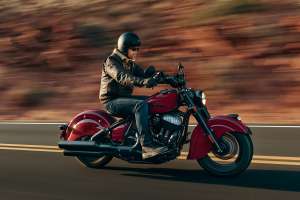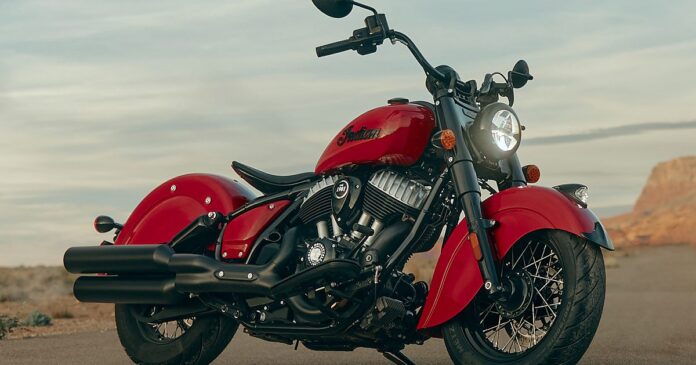
When Polaris announced that it was selling a majority stake in Indian Motorcycle to the private equity firm Carolwood LP, the internet buzzed with the usual chatter that accompanies such announcements. But despite the naysayers, the American marque hasn’t skipped a beat.
This year marks Indian’s 125th anniversary, and they’ve kicked off their celebrations with one heck of an opening salvo. Meet the new Indian Chief Vintage—a thoroughly modern homage to the golden age of American motorcycles.
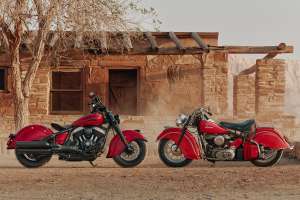
The first Indian Chief hit the streets in 1922, but it was the elegant, Art Deco 1940s Chief that inspired the 2026 Chief Vintage. “The Indian Chief from the 1940s remains one of the most recognizable and celebrated motorcycles in American history,” says our good friend and Indian’s design director, Ola Stenegärd.
“With its iconic V-Twin engine, valanced fenders, and unparalleled reliability, the Chief set a standard for performance and design that resonates today. It represents the spirit of Indian Motorcycle—bold, timeless, and always pushing forward.”
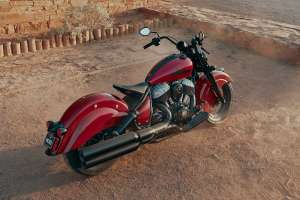
The parallels between the Indian Chief Vintage and its ancestor are clear as day. The modern Chief chassis works well here, creating the perfect vintage cruiser silhouette. The standard issue Chief fuel tank is a good fit too, while the Chief Vintage’s wide handlebars and low-slung bobber seat offer the sort of ergonomics that suit a motorcycle of this ilk.

Of course, it’s the Chief Vintage’s gigantic valanced fenders that really stand out. According to Ola, Indian’s design team 3D-scanned the fenders from a 1948 Indian Chief, to get every surface just right. And although they’ve been adapted to suit the modern Chief platform’s proportions, they are pitch-perfect.
The other throwback details are subtler, but no less impactful. Indian coated the V-twin motor’s cylinders in black and its heads in silver, as a nod to the black and raw aluminum finishes on the older engine. The slightly-forward-mounted floorboards have a vintage vibe, and the front fender’s iconic headdress adornment mimics that on the 1940s Chief (except now it lights up).
One feature that gives the Chief Vintage a decidedly modern vibe is its extensive use of black. Gone are the chrome strips that run along the original bike’s fenders, and most parts that would traditionally be finished in raw metal or chrome are now blacked out. It establishes the bike as a contemporary interpretation rather than a replica, and it works.
The Indian Chief Vintage also borrows a number of parts from its stablemate, the Chief Bobber. It uses the same enclosed forks and rear shocks, offering 132 mm travel up front and 75 mm out back, and the same LED headlight and nacelle. It also gets similar 16” laced wheels to the Bobber, although the rear hoop is narrower to better suit the vintage aesthetic.
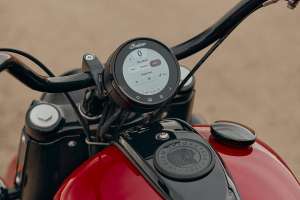
The bike’s burly twin exhausts and round digital dashboard are jarring when set against the myriad retro details. While we can live with the exhaust, the Chief Vintage deserves a stealthier speedo that covers just the bare essentials. That said, the standard-issue Chief dash packs in a ton of information, access to connectivity and navigation features, and software that the bike most likely can’t run without—so it’s a necessary evil.
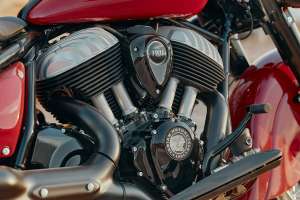
Under the hood, the Chief Vintage gets Indian’s air-cooled 116 ci Thunderstroke engine. There’s 156 Nm on tap, a six-speed transmission with a wet multi-plate clutch, and three switchable riding modes. It tips the scales at 327 kilos [721 pounds] wet, with a modest seat height of 686 mm.
The overall package speaks to a very specific rider; one who wants a bare-bones bobber with looks that reference a particular era, but also wants a V-twin with chunks of torque and is willing to pay a premium for it. It’s a big swing from Indian, but they’ve knocked it out the park. The Indian Chief Vintage is gorgeous in both colors it comes in (red and black), while perfectly nailing the neo-retro balance.
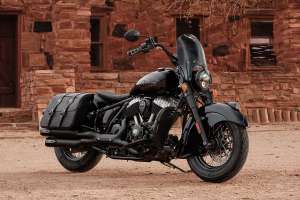
It even looks good with Indian’s factory accessories, which range from faux leather panniers and a windscreen to passenger accommodations, crash bars, and more. Even with some of those fitted, the Chief Vintage’s riding position might limit how many hours you can spend in the saddle—but we’d be willing to test that limit.
Source: Indian Motorcycle