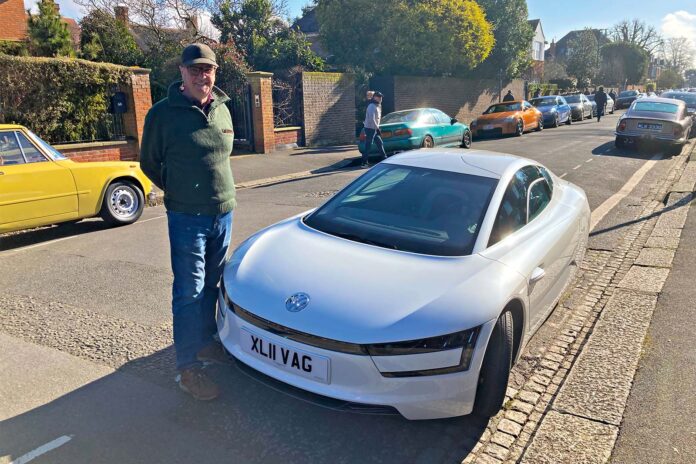
Parked on a suburban side road, David Power’s Volkswagen XL1 looks as though it has just landed from outer space. One of its two butterfly doors is open, attracting curious passers-by.
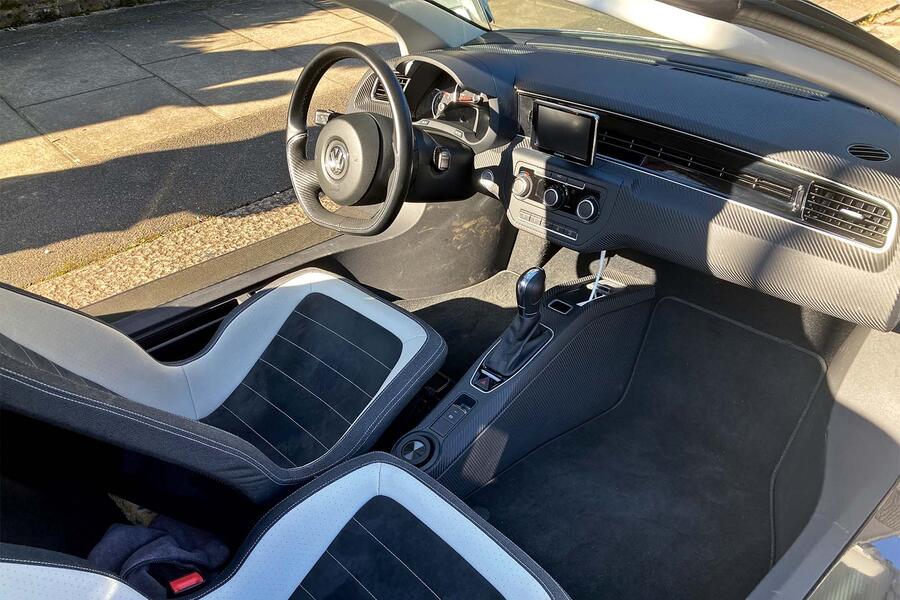
“Everyone stops to look at it,” he says, clearly enjoying their delight. This miniature two-seat coupé (the occupants sit slightly offset) is a diesel-engined plug-in hybrid with a carbonfibre body, digital side ‘mirrors’ and a drag coefficient of just 0.186 – 2.5 times lower than a contemporary Volkswagen Golf.
Its 800cc two-cylinder engine produces only 46bhp and its electric motor 26bhp, but it weighs a mere 795kg.
The XL1 started life in the early 2000s as a development project for fuel-saving and emissions-reduction technologies, and the 2013 production version could do a claimed 313mpg in diesel-electric mode or 140mpg in diesel mode while emitting just 21g/km of CO2.
David picks up the story: “The XL1 took 10 years to develop and was Volkswagen chairman Ferdinand Piëch’s dream of a 1.0-litre car – that is, one capable of travelling 100km on one litre of fuel. It was also a project to drive down carbon emissions, but the [Dieselgate] scandal broke just as it was released.
“So VW on the one hand designing a diesel that could do 300mpg and on the other cheating [in official emissions tests] didn’t look good!”.
As the founder of Powerflex, a designer and manufacturer of suspension parts, David is unsurprisingly fascinated by the XL1’s engineering. “It’s not a range-extender,” he explains. “The rear-mounted diesel engine and electric motor can work together or independently of each other. With enough charge, it will run in EV mode only, and the motor and engine work together when you accelerate hard.
“The 313mpg figure is achieved in the drive cycle when it uses a lot of battery and not much diesel. On a long journey, it uses more of the diesel engine, and I’ve had 150mpg out of it. It has no power steering and doesn’t need to.
It’s lovely to drive and can accelerate quite briskly. What I like is that it’s a proper VW product. The body is stiff but the car rides well; the suspension has good travel and control.”.
David reckons the XL1’s tyres are narrower than a Citroën 2CV’s. VW made 250 XL1s, all of them with left-hand drive, and of the 200 earmarked for retail, only 30 were offered to the UK. New, each cost £100,000.