Welcome to the RACER Mailbag. Questions for any of RACER’s writers can be sent to mailbag@racer.com. We love hearing your comments and opinions, but letters that include a question are more likely to be published. Questions received after 3pm ET each Monday will be saved for the following week.
NOTE: Kelly Crandall is on vacation, but your NASCAR questions will be answered when she returns.
Q: With the announcement of the new Independent Officiating Board (IOB) in IndyCar, I want to know if this new board will have authority over making calls in a race? Specifically, will the IOB be in charge of officiating the Indy 500 and determining when it is appropriate to red flag a race? I want to know if the responsibility for red flagging a race, like we saw at the end of the 2023 Indy 500 – leading to the last lap shoot-out between Ericsson and Newgarden – now falls under the new IOB’s responsibility.
Kevin P, Los Angeles, CA
MARSHALL PRUETT: Great questions. No, the IOB will not be positioned in race control or anywhere else to call balls and strikes as the Indy 500 or any other IndyCar race is happening. That’s what IndyCar president Doug Boles told us a few months ago, and I’ve heard nothing to counter those details.
The IOB is a new managerial layer that replaces Penske Entertainment as the bosses of the people who officiate IndyCar events. Unless there’s a surprise twist on the way that I don’t know about, this is the equivalent of an emancipation of the officials from Penske Entertainment with the insertion of new leaders from the IOB.
Yes, the IOB is responsible for all aspects of administering IndyCar’s races from an officiating and compliance capacity. If you love the calls coming out of race control, credit IndyCar Officiating, Inc. (IOI, the new non-profit parent company formed by Penske Entertainment to house the IOB, managing director of officiating (MDO), and all IndyCar officials.) And if you hate a call, the IOI, MDO – once that person is hired – and the IOB members will be the ones to blame.
We don’t yet know who will be in charge of race control, but I won’t be surprised if longstanding race director Kyle Novak continues in the position. Same goes for driver stewards. Arie Luyendyk and Max Papis have been that solution for many years, and as I’ve been reminded, Novak hasn’t been the one acting as judge; if Driver A ran Driver B into the barrier, it’s Arie and Max who’ve given Novak and the rest of the officiating team the thumbs up or thumbs down on assigning a penalty.
A question I need to get answered is how the IOB will shape how the races are called. Penske Entertainment said the IOB will follow the rules written by IndyCar, which makes sense, but the secondary part of race officiating has been the penalty guidelines used by the stewards to handle most situations that arise. The rulebook is the proverbial ‘letter of the law,’ while the penalty guidelines fall closer to the ‘spirit of the law.’
It’s here, with the spirit side of officiating, where I’d expect the members of the IOB and the MDO to make their presence felt. And not by telling race control how to rule on each incident, but with the tone of their officiating. Like we see in stick-and-ball sports, some officiating crews are hardcore from the first second of action and hammer the players for the slightest things, while others are more lax and only blow the whistle for the egregious fouls.
New bosses, new expectations for their ‘spirit of the law’ views to be infused within race control, just as it was by the old bosses.
Q: Why exactly did IndyCar end up cutting Jay Frye? He was such an involved individual and seemed to really put in a ton of effort to elevate the series, and you can kinda see it with the rise in teams shortly after his implementation. Just doesn’t make any sense for them to cut a guy who was so boots on the ground and involved in the operations.
Austin Blayney, Texarkana, AR
MP: He was given no explanation and Penske Entertainment has only spoken on the record about wanting to appoint Doug Boles, who they felt offered greater strengths in some areas. What we knew within the paddock is that Frye was not aligned with Roger Penske and Penske Entertainment CEO Mark Miles on a range of matters and clashed with them on a repeated basis.
Frye served as IndyCar president for five years under Hulman George ownership, and when they sold to Penske, the new series owners wanted things done however they chose, and Frye is said to have stuck to his beliefs and pushed back repeatedly. Whether he was right to hold the line is immaterial; if the company you work for is bought and the new owner wants things done differently, you either comply, push back and hope the owners see your way as the best way, or leave. Frye tried the second option, was miserable for the last two or three years there, and he’s also incredibly loyal, which meant he would never quit.
With hindsight, I’m happy he was fired, for his own sake, because he’s much happier in all areas of his life. Boles also appears to be thriving in his new role.
Frye and Boles both seem to be in a happy place since the IndyCar leadership shake-up. Walt Kuhn/Penske Entertainment
Q: Exciting and encouraging developments happening with the IR28 chassis; thanks for putting those first two updates together. Taking present realities into consideration, the picture that is developing feels both understandable and exciting.
One potential development that I would be disappointed to see take place would be that of moving the remaining driver adjustment tools to the steering wheel. One of the more enjoyable aspects of in-car camera views is watching drivers making the adjustments using the tools mounted at their side. It effectively and engagingly highlights an area where the driver is making a difference.
Moving those tools to the steering wheel greatly diminishes that spectacle.
Kristopher Strebe. Seattle, WA
MP: Early in my career as a racecar mechanic, around 1989 or 1990, I had a desire to come up with a semi-automated anti-roll bar adjustment system in the junior open-wheel cars I worked on. Most of the ARBs had five adjustment positions where you’d push or pull the lever and lock the adjuster cable into place. My idea, and this was before digital dashboards and hydraulic/electro/pneumatic actuation was normal, was to have five buttons to push, with the first being the softest ARB setting to the hardest being the fifth and last button to press on a panel affixed to the front of the cockpit that was above the top of the steering wheel.
The concept had nothing to do with safety and trying to get levers out of the cockpit; it was to give drivers a fast and easy way to change the front and rear ARBs to provide optimal handling in different types of corners. Want something soft and supple exiting a hairpin, boom, press your buttons and you’ve got it in an instant. Fast corner ahead and you want a stiff platform? Hit your buttons, and so on. Fishing around and trying to row through the adjuster handles took too long and wasn’t always precise.
Well, I didn’t know how to make my pushbutton ARB change system to optimize corner-by-corner handling back 35 years ago, but if the idea floated by IndyCar’s Mark Sibla comes to fruition, my old idea should be possible via the steering wheel, just as the fast-acting weight jacker is used to swiftly collapse or expand the jacker and shed downforce on the Indy 500’s straights or return the cars to their full cornering potential on approach to Turns 1 and 3.
Teams place potentiometers on their ARBs so they and the drivers know the settings at all times. Maybe that’s something for IndyCar and FOX Sports to work into the broadcasts.
Q: Great coverage of the upcoming IR28. I have a couple of random questions.
Aerodynamics and DRS: Is there no interest on IndyCar’s part to have flexing wings for road course package to cut down on drag, weight and increase top speeds? My small mind thinks flexible means light weight, but that might an over simplification on my part.
Hybrid/Powertrain: Any consideration being given to the 2.4 engine being spec and open the MGU to development? Or keep the 2.4 open and have the hybrid spec for the first couple years then eventually open that up too. I feel like Honda wants open development on the MGU side more than the engine.
Do you see anywhere on the car that could be opened up for development without breaking the bank and have a positive effect for everyone?
Derek M., Perry, GA
MP: Flexible wings – IndyCar drivers tend to make a lot of contact with each other, so I’m guessing robust wing construction will continue in favor of thinner/lighter/flexible wing elements that would be turned to dust by the end of a street race.
Engines/Hybrid – there was plenty of conversation about going mostly or fully spec on the internal combustion side (which we heavily explore in a number of upcoming IndyCar 2028 pieces) in order to open up the energy recovery side for playing and individual expression. The final decisions inverted that concept. Whether the ERS could become open in the future is TBD.
I’ve spent many hours trying to think of that thing to open up and create unique solutions of visible differentiation for manufacturers or teams, and keep striking out. Open shocks are no longer wanted due to the costs. Open aerodynamics were tried from 2015-2017 and the manufacturers nuked tons of cash while drawing no meaningful growth to the series with TV ratings or ticket sales, and no known increase in vehicle sales, so that brings nothing but bad financial memories. Wheels are spec. Aero is spec. Engines are required to be 2.4 liters and V6s. ERS is spec. Gearbox is spec. Electronics will be spec.
I just don’t know what else to consider for leaving open that hasn’t been locked in as spec and would bring real personality or difference without a giant price tag. Maybe Mailbag readers can help with ideas I’m missing.
Q: Mt Rushmore of IndyCar pit reporters. I have to go with Jon Beekhuis, Gary Gerould, Calvin Fish, and Kevin Lee. What do you think?
Ed, Jersey
MP: Strong ballot. But it’s incomplete without Jack Arute.
Q: While I imagine the chances of Penske Entertainment doing this are between zero and none, I have been a proponent for some time now of the Indy 500 allowing ‘special’ entries along the general idea of Garage 56 at the 24 of Le Mans, as a way to allow for innovation in a very controlled way.
Years ago, this would have been a fun yet practical way to explore the DeltaWing concept (without building an entire fleet of them). In the current case, it would be IMS telling JR Hildebrand ( Blackbird 66Mk.1 ) and Lola (DGR-Lola FE car) that if they can find a way to build their concept cars, then they are welcome to enter the Indy 500 as ‘special’ entries, provided of course that they can qualify fair and square as one of the fastest 33.
This would allow for a chance to make qualifying weekend really interesting to the broader motorsports world (who doesn’t want to see the 66Mk.1 lapping IMS at full fury on a warm day in May? Or see how a super-modified FE car would do trying to qualify for Indy?)
It would also allow for a glimpse of innovation while preventing the aero arms race of having the current NTT IndyCar Series teams building and modifying their own chassis. It also has the built-in excuse that if one of these Garage 56-esque entries did very well against the established IndyCar Dallara formula, well, they were ‘special’ entries allowed to play outside the rules.
Are there any chances that IMS and IndyCar would ever allow for something – event exhibition runs – of outside-concept cars?
Nick, Wisconsin
MP: You have to start with the ‘what would everybody complain about’ part first and work your way backwards to the answer. This one doesn’t need much to get to the conclusion. Every team owner and engine supplier would lose their minds over the thought of a ‘Gasoline Alley 34’ entry lapping faster than their cars and engines, showing up their sponsors who all pay the most money or the majority of their money for the season to be seen at Indy, and/or capturing more media attention, even if the special entry isn’t quicker over the course of a lap.
It’s 100-percent downsides for everyone on the team and competition side, unless the GA34 car chokes and sucks, which then brings embarrassment to the event (that’s thinking about it from the series’ side).
The spirit of innovation and trying to beat each other with better machines that are different from each other died within most IndyCar team owners long ago. Everyone’s petrified of not being equal, and once that fear was removed by making damn near everything spec, there was never a chance of going back to the old ways pitting different engines against different chassis models shod with different tire brands.
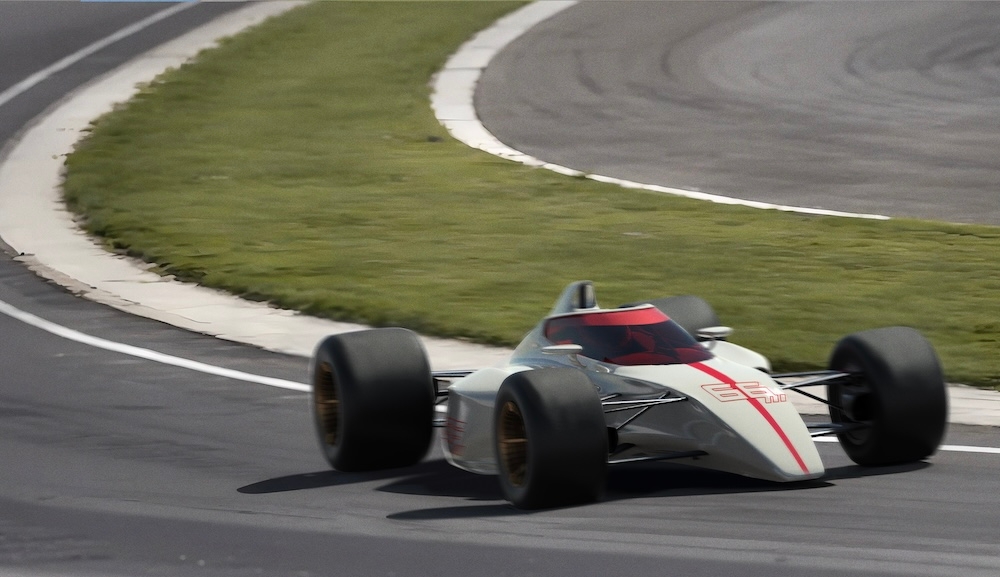
Seeing Blackbird 66 Mk.1 in the field of 33 would be super fun, but also super impractical. Image by Patrick Faulwetter
Q: Long time lurker, first time caller. With all the conversations surrounding full-time entries for the 2026 IndyCar season (and only one open seat remaining with my neighbors down the street), very little has been said regarding the additional Indy 500 entries. Any news from DRR (who had one heck of a run last year) or any of the teams who might field additional entries?
Dave Lundin, Woodridge, IL
MP: DRR will be two cars again. Just a question of who’ll replace Ryan Hunter-Reay. Daly is the obvious name to return there and go for the win. We know Andretti will have an extra car, and Arrow McLaren has RHR. Last time I asked, Ganassi wasn’t planning on doing an extra car and Foyt has been reluctant to do so while in its alliance with Penske. Carpenter will be back as a 500 entry, as will Castroneves with Meyer Shank. RLL will have Sato back. There are a few other names I’ve heard of as potential 500 entrants, but PREMA’s driving the bus on engine availability.
If they’re in, the entry list should mirror what we had in May, and I only hear that they’re in. But if not, it could get fun.
Q: Do the manufacturers involved with IMSA pay a fee to compete? Also, are we going to see more coverage via the internet ? I don’t have internet access, so I missed a lot of IMSA’s coverage last year. Which is a shame, because I think it’s the best series in America right now.
Rob
MP: There was a lot made of a mandatory annual marketing and promotions fee back when the DPi era launched in 2017, and I don’t know of any changes to it since then. The rumored annual minimum per manufacturer was $1 million.
Yes, every racing series is doing more coverage via the Internet. I’m also realizing just now that if you don’t have Internet access, I’m not sure how this was sent or how the response will be seen.
Q: Let’s say the next great open-wheel racer has a sudden growth spurt. Suddenly, they are 6’10″. Are they going to fit in an IndyCar or an F1 cockpit? Would the cars suddenly get longer, or would the long, tall driver have to go elsewhere?
Isaac, Fruitport MI
MP: Sizing’s easy. If you’ve been in an apartment building or house from the 1920s or 1930s, trying to navigate the halls and stepping through doorframes is reminder of how the average was tiny compared to what we are today. Same with a lot of old-timey race cars. If most drivers were to become NBA size, there’s no place for them to go in any series right now, so changes would be made.
Q: Based on gut feeling and rumor alone; as the NASCAR trial continues, what’s the odds we might hear the reason IndyCar has been limited on ovals is part of NASCAR’s anti-trust activity?
Shawn, MD
MP: I don’t know if the lawsuit is/was needed to answer this one.
NASCAR has kept IndyCar off its ovals for a good while, with select exceptions. It let IndyCar pay and rent Iowa Speedway, which just came to an end. WWTR/Gateway is privately owned by Curtis Francois. The Milwaukee Mile is owned and operated by the Wisconsin State Fair Park. Nashville Speedway is owned by Speedway Motorsports Inc. IndyCar’s return to Phoenix Raceway, a NASCAR-owned track, is the only one of its kind for the series in 2026, and comes via FOX Sports facilitating the quick in-and-out appearance on the Friday-Saturday of the Cup weekend.
I covered a Grand-Am race many years ago at Daytona during the NASCAR Cup summer race there. It was a strange thing with Cup and the other series up on the oval and Grand-Am using the roval during the same event, so IndyCar won’t have that to deal with at Phoenix, but the feeling of being the irrelevant member of the race weekend was present the entire time with Grand-Am. In and out by Saturday, and nobody cared. And then Grand-Am went back to being the headliner at its own events. We’ll see what it’s like for IndyCar on the NASCAR Phoenix undercard in March…
Q: I know we’re waiting for another engine supplier to join IndyCar with hybrid technology – is Honda in or out? Toyota is now a sponsor for Haas in F1 without suppling a powerplant, DRS is going away and more battery power is coming in for a version of PTP. When is this nonsense going to stop?
I’m all for ways to slow/stop global warming, but we’re talking about the most advanced racing cars in the world here! Just go through YouTube, back to any Indy car/F1 race in the ‘90s, close your eyes and just listen to those V10s and turbo V8s just screaming down the track. This is what racing is all about.
We need to bring some form of this back, and the sooner the better. The hollowed grounds of Indianapolis and Monza need to hear this, not the hum of Singer sewing machines buzzing around.
Joe, LA
MP: I love the idea of breaking the news about Honda in the Mailbag. Once I have an answer, it will be shared.
No need to significantly rehash what I’ve written many times, but yes, if IndyCar’s engine suppliers don’t demand hybrids or small-displacement turbo V6s as a condition of their participation, I’d love to see and hear something bigger and better.
Chevy gives the impression of being indifferent to IndyCar’s hybridization, at most, and we know the Bowtie loves its naturally-aspirated motors. Honda’s known to be a lover of small turbos and hybrids. Who knows what a new manufacturer would want.
But if a third emerged, and sided with what I think Chevy might be up for, Penske Entertainment would have the ability to change direction without risk of being a single-manufacturer series.
Q: It’s been reported several times that IndyCar leadership wants to shrink the field to 25 cars if PREMA folds. Is there any explanation as to why? It doesn’t seem like the operating cost for the series would be dramatic different at 25 vs 27 cars.
Also, I think Sting Ray Robb is getting an unfair treatment from IndyCar fans. His performance was essentially identical to Louis Foster and Nolan Seigel, who were both in way better cars than him. Sting Ray was only 80 points behind Daly (same points difference as there was between Herta and Dixon this year), who is way more experienced than him. Robb probably isn’t a future champion, but he shouldn’t be the face of IndyCar pay drivers, either.
Will, Indy
MP: Lots of motivations for shrinking the field. Penske Entertainment CEO Mark Miles has put the number at 22 in conversation with team owners, driven by seeking higher quality entries, in theory, and greater value/exclusivity with fewer entries, which some team owners have been calling for to raise the value of their charters.
On Sting Ray, come on, man. He’s out-performed other paying drivers like Benjamin Pedersen and Jacob Abel in his three seasons, but he’s the only paying driver to finish 20th or lower in the standings all three years. If Pedersen or Abel or Devlin DeFrancesco were in for the same three-year stretch, I could see the argument for saying one of them was the face of paying drivers, but he’s the lone constant over that span. Siegel’s fair game for parallels, but you lost me with the mention of Foster.
Q: Will the NASCAR settlement have any repercussions in IndyCar regarding the charter system?
Vincent Martinez, South Pasadena, CA
MP: Great question. Nothing for now, but I imagine IndyCar’s team owners have a lot to think about for the future.
THE FINAL WORD
From Robin Miller’s Mailbag, 17 December, 2014
Q: If you could get an exclusive, 20-minute interview with Bernie Ecclestone, what would you ask him?
Marc, Orange County, CA
ROBIN MILLER: I’d ask if he remembers me calling his house at midnight in 1979, waking him up and asking him a question about Porsche that he refused to answer before slamming the phone down. Then I’d ask him (have to use a polygraph) just how scared of CART was he in 1993 when ol’ Nige defected?

